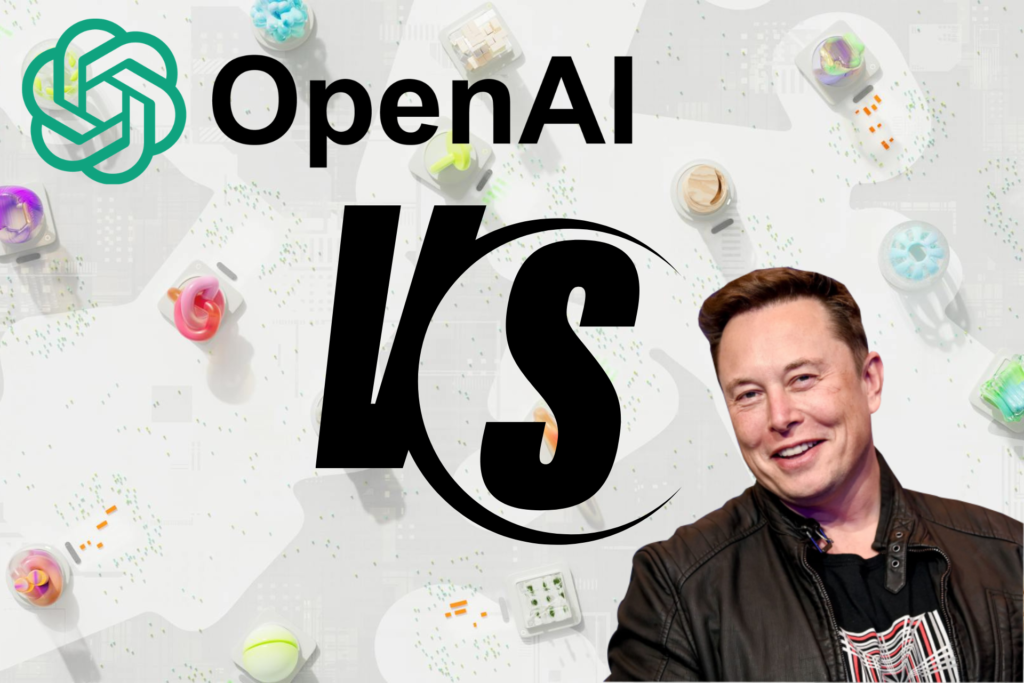
The story of OpenAI is no longer just a tech fairytale about saving the world from Google’s AI dominance. It has morphed into a high-stakes courtroom drama set to explode in a jury trial in April 2026 . With unsealed diaries, accusations of fraud, and a competing AI company (xAI) now merging with SpaceX, this saga is about to reveal the raw nerves of Silicon Valley’s soul.
This isn’t just a story about code and contracts; it’s about ego, the definition of “open,” and what happens when saving the world becomes a very lucrative business.
The Founding Ideals: A Pact Written in Code
To understand the venom in this feud, we have to go back to the beginning. In December 2015, OpenAI launched as a non-profit. The board members—Elon Musk and Sam Altman among them—pledged to develop AI openly and counteract the gravitational pull of giants like Google .
At the time, Musk was the star power. According to court filings, he provided the bulk of the early seed funding (approximately $38 million), recruited top talent, and lent the organization his considerable credibility . The argument Musk makes today is simple: his money came with a handshake deal—a “founding agreement”—that OpenAI would remain a non-profit, open-sourced charity .
For a while, it worked. But by 2017, the seeds of discord were already sprouting. AI research was getting exponentially more expensive. The non-profit model, it seemed, couldn’t compete with the compute power of Google and the allure of stock options for top researchers.
The Schism: “We Need Billions, Not Donations”
This is where the story gets murky. Recently unsealed documents, including the private diary of OpenAI President Greg Brockman, paint a vivid picture of the internal conflict . In 2017, the team realized they needed “billions” to win the AI race, not just charitable donations.
The Truth Elon Left Out
According to OpenAI’s recent blog post titled “The Truth Elon Left Out”, Musk was fully aware of and initially in agreement with the need to become a for-profit entity—until he didn’t get his way. OpenAI alleges that Musk wanted the majority equity and full control of the company. In a revelation that sounds like science fiction, they claim that during discussions about succession, Musk suggested his own children should control AGI. When OpenAI refused to hand over the reins, Musk walked.
He proposed merging the startup into Tesla, and when that was rejected, he quit in 2018, allegedly telling the team they had a “0% chance of success” without him.
Musk’s camp sees this differently. They point to Brockman’s diary entries where he questions the morality of the pivot. “Cannot say that we are committed to the non-profit,” Brockman wrote. “If three months later we’re doing b-corp then it was a lie” . This, Musk’s lawyers argue, is the “smoking gun” proving that Altman and Brockman were planning to defraud him from the moment they took his charitable donations.
The Betrayal: From Altruism to AGI for Profit
After Musk’s departure, OpenAI’s transformation accelerated. In 2019, it created a for-profit arm and accepted a $1 billion investment from Microsoft . By 2022, ChatGPT had taken the world by storm, and OpenAI became the hottest property in tech.
For Musk, watching from the sidelines, this was the ultimate betrayal. The “open” in OpenAI was gone. The company was now a closed-source, profit-driven behemoth, tightly integrated with Microsoft. By 2023, Musk had founded xAI to compete directly, and the legal war began .
The vitriol spilled into public view in August 2025 when Musk tweeted that OpenAI was going to “eat Microsoft alive.” Sam Altman’s response was dismissive: “I don’t think about him that much” . But behind the scenes, the legal machinery was grinding.
The Trial Showdown: What Will April Reveal?
As of early 2026, the stakes have never been higher. On January 15, US District Judge Yvonne Gonzalez Rogers ruled that Musk’s case has enough merit to go before a jury, rejecting OpenAI’s attempts to have it thrown out .
The “Cherry-Picked” Evidence vs. The “Harassment Campaign”
Musk is seeking a staggering sum—between $65.5 billion and $134.5 billion—claiming that is his share of the “wrongful gains” derived from his early contributions . He argues that without his seed money and expertise, OpenAI would be nothing.
OpenAI counters that Musk is engaging in a “harassment campaign” designed to slow down its progress and boost his own xAI . They have warned investors to expect “deliberately outlandish” claims from Musk as the trial date approaches .
The Greg Brockman Diaries
The most explosive evidence so far is Brockman’s diary. Judge Rogers cited these notes in her decision to move forward, specifically noting entries where Brockman worried about the ethics of cutting Musk out of the profits . Brockman even wrote that converting to a for-profit without Musk “would be pretty morally bankrupt” . This puts OpenAI in a difficult position. They must convince a jury that private musings in a diary are just that—private thoughts—while the actual business decisions were made in good faith.
The xAI Factor: Competition in the Courtroom and the Cosmos
You cannot view this lawsuit without looking at Musk’s parallel moves in the market. On February 3, 2026, Musk announced that xAI would merge with SpaceX, creating a combined entity valued at $1.25 trillion .
This is a direct threat to OpenAI. While OpenAI is spending billions on data centers, Musk is planning to put them in space. SpaceX has a healthier balance sheet, a looming IPO, and access to vast amounts of real-world data from Starlink .
Furthermore, Musk’s xAI recently lost a bid to sue OpenAI for stealing trade secrets, with a judge signaling she would likely dismiss the case . This suggests that Musk’s primary weapon against his former ally is now entirely focused on the April trial regarding the non-profit breach.
The NeuroAI Gambit: The Next Battlefield
Beyond the courtroom, the battle for the “human operating system” is heating up. According to industry analysis, Musk’s vision with Neuralink is about merging human cognition with AI, creating a symbiosis that goes beyond text prompts .
Interestingly, OpenAI appears to be countering this by investing in brain-decoding technology, funding startups like Merge Labs to translate neural activity directly into tokens . The fight is no longer about who has the best chatbot; it’s about who will control the interface between the human brain and the machine.
| Aspect of the Feud | Elon Musk’s Position / xAI | OpenAI’s Position / Defense |
| Core Origin Story | Co-founder who provided seed funding & talent under a “non-profit” pact . | Acknowledges Musk’s role but claims he wanted full control & for-profit status early on . |
| Key Evidence | Brockman’s diary entries questioning the ethics of the for-profit pivot . | Musk’s 2017 emails demanding majority equity & a Tesla merger . |
| Current Legal Goal | $134B in damages for “wrongful gains”; prove fraud . | Dismiss lawsuit as “harassment”; protect for-profit transition . |
| Competitive Strategy | xAI merging with SpaceX ($1.25T value); using space-based data centers & Starlink data . | Massive compute investment ($1.4T); securing content deals with publishers . |
| Future of AI Vision | Neuralink integration; “intelligence upstream in the brain” . | Investment in brain-decoding (Merge Labs); faster “brain tokens” . |
Conclusion: A Trial That Redefines Silicon Valley
As we approach April 27, 2026, the tech world is holding its breath. This trial will force a jury to answer a question that has haunted Silicon Valley for decades: Can a company founded on altruism pivot to profit without betraying its original donors?
If Musk wins, it could set a massive precedent, making investors wary of donating to non-profits that might later turn into unicorns. If OpenAI wins, it validates the Silicon Valley mantra that “moving fast and breaking things” includes breaking your founding promises if the technology demands it.
One thing is certain: the “open” in OpenAI has long been closed. Now, we wait to see if the courts will force it to open its wallet.
What do you think? Is Elon Musk fighting for the soul of AI, or is this just a billionaire’s regret for walking away too soon? Share your thoughts in the comments below and subscribe for updates as the April trial unfolds!
If you want to learn more about WordPress Security, click here. If you want to learn how to earn online as a student, click here.